
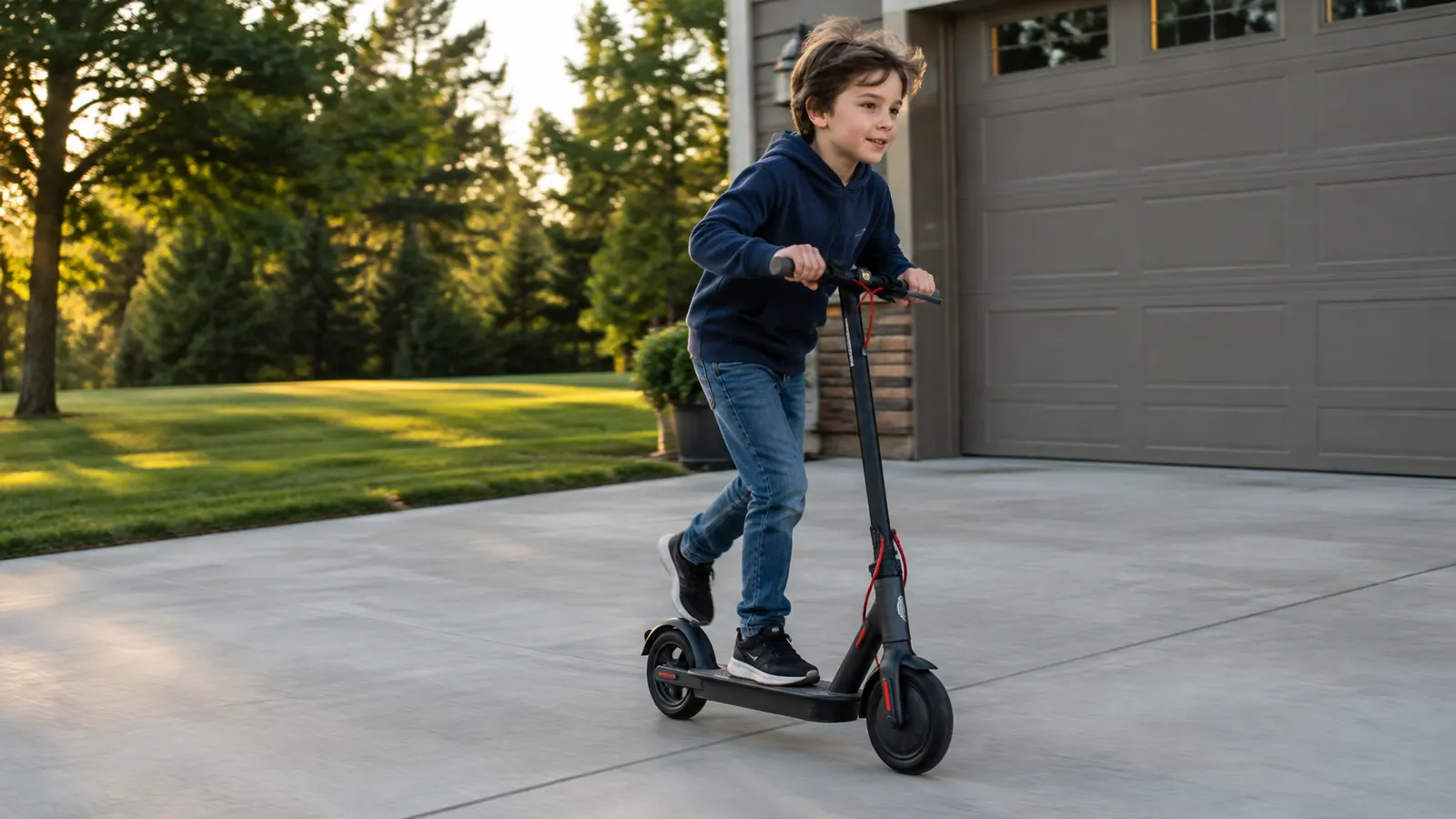
I will get the headline out of the way: the Gotrax Kids Electric Scooter is a good first electric ride, and it is also the easiest thing on our property to outgrow. I bought one last summer for my son Cody, who was 9 then and is 10 now, about 4 foot 7 and 75 pounds. He rides it almost every day the weather allows. He also understood in the first week why it stays off the gravel driveway, because small wheels like these are not built for gravel, and that is exactly the kind of thing a listing does not say out loud.
This is the honest review version of the story. The listing says up to 7.5 mph, up to 3.75 miles per charge, for kids 6 to 12. All of that is true. What nobody tells you is how those numbers feel in a real driveway, what a thumb throttle does to a kid who has only ever pushed a kick scooter, and how fast a 10-year-old stops being the right size for it. I am a dad who does his own assembly, charging, and brake checks in the garage, and I buy these things with my own money. Here is what I learned from a summer of watching Cody ride laps on the concrete pad.
The Quick Verdict
A capable first electric scooter for a kid in the 6 to 10 sweet spot who has smooth, flat ground to ride on. The limits are real: short range, smooth surfaces only, and a size ceiling that comes sooner than the box suggests.
Amazon Check Today's Price →The right first electric scooter, if your kid has a smooth place to ride it
We bought ours with our own money, and it has held up through a summer of daily laps on the concrete pad. If that matches your setup, it is worth a look at today's price.
Amazon Check Today's Price on Amazon →How I've Used It
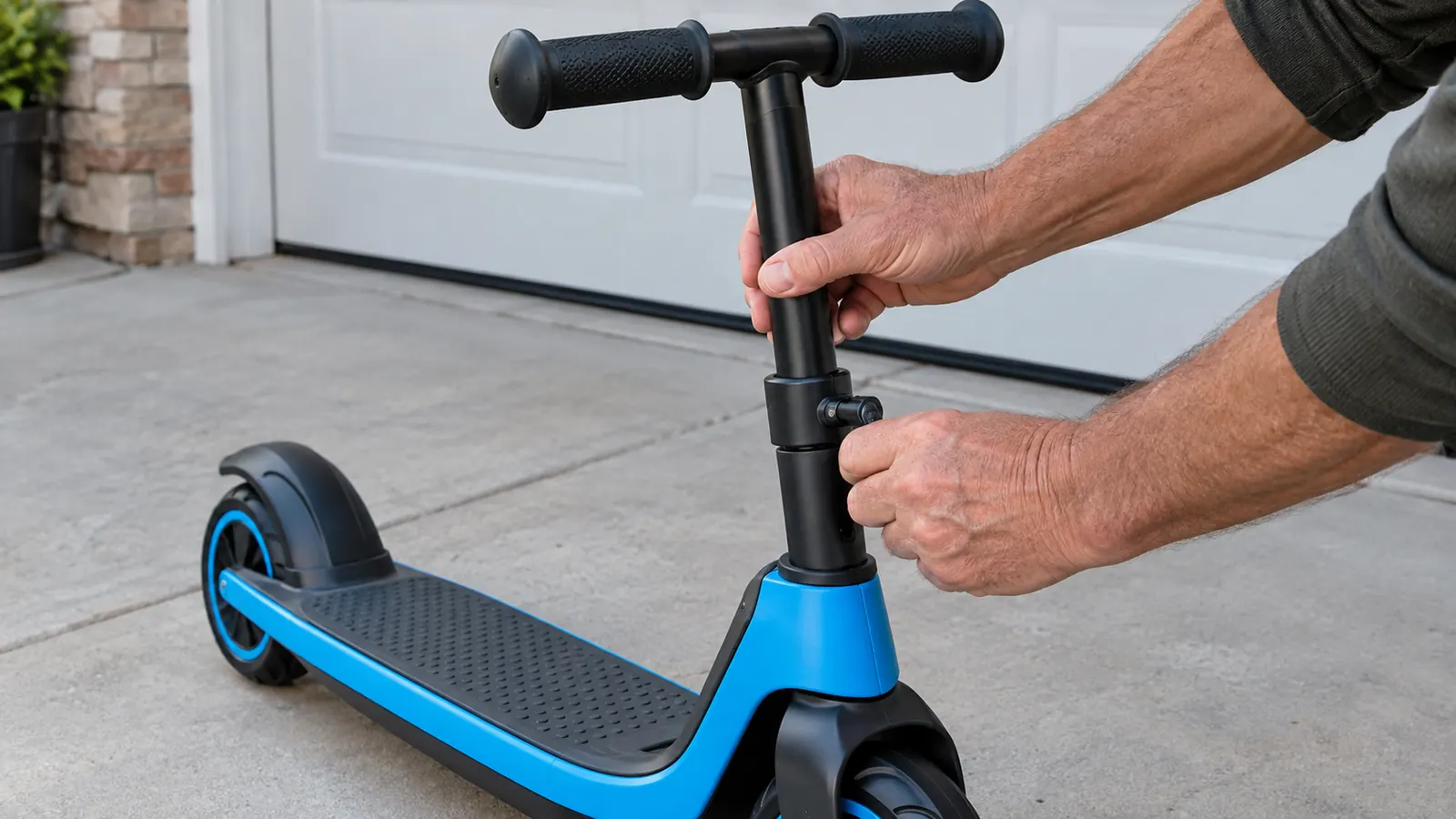
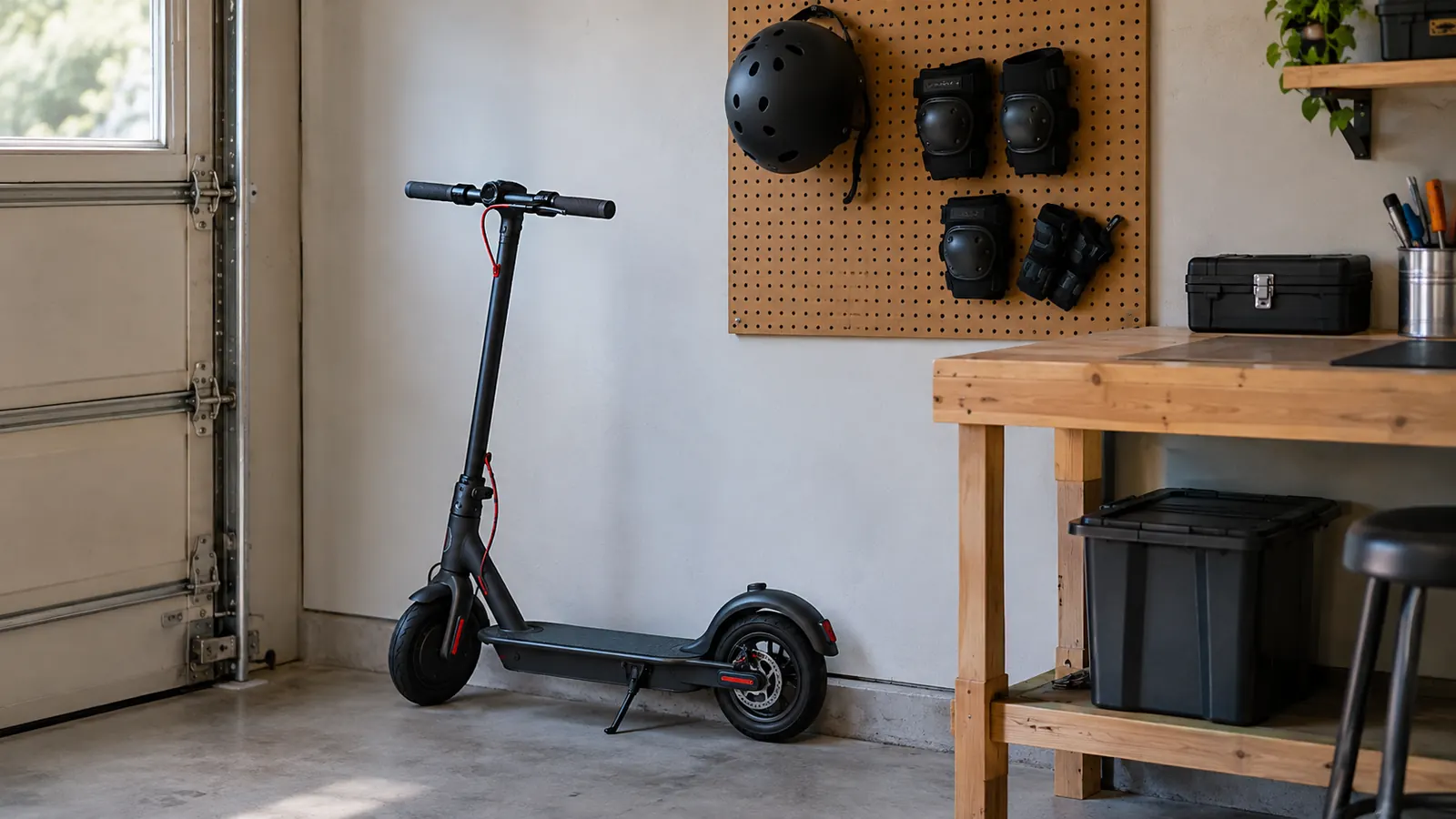
The scooter lives in the garage on the workbench side, and it charges on the wall outlet after every ride. It came out of the box mostly assembled. I put the handlebar on, tightened a few bolts, checked the brake, and charged the battery fully before the first ride. That is the whole story. The setup took about 20 minutes, and I am not a professional mechanic, just a dad with tools. Everything I know about these things I learned by reading the manual and then checking the work myself.
Cody rides it on the big poured concrete pad in front of the garage, the one that doubles as a basketball half court. That surface matters more than any spec in the listing. The scooter is happy on smooth, flat, dry ground and nowhere else. I have never let him take it onto the gravel driveway or the grass back yard, because the small wheels are built for smooth pavement and the pad is all it needs.
Every ride starts with his helmet on, closed-toe shoes, and one of us outside with him. He never rides on public roads. That is not a lecture, it is just the rule in our house, and it is the rule I would give you too. Before the season and after any crash, I check the brake and the tires. So far the scooter has needed nothing but a charge and a wipe-down, which is the best thing I can say about any piece of kid gear.
What Nobody Tells You About the Battery
The Gotrax Kids Electric Scooter lists up to 3.75 miles per charge, and that number is honest. It is also the number that misleads people, because nobody rides a kids electric scooter in a straight line for 3.75 miles. Cody rides loops on the pad: start, stop, turn around, start again. That kind of stop-and-go riding eats range faster than a steady cruise would. A full charge covers a good afternoon of riding with breaks. It will not cover a whole day, and it will not stretch across a week of daily rides. We charge it overnight, every time, so it is never a surprise the next morning.
Here is the part I did not see coming: the battery is the first thing you will notice aging. The scooter is about a year old now, and it still holds a full afternoon of pad riding on a charge. I expect that to fade over the next season or two. That is what batteries do, and the listing does not hide it, but it also does not say it out loud. If your kid rides twice a week, the battery will probably outlast the novelty. If your kid rides every day like Cody does, plan on charging every night and plan on the range shrinking a little each year.
The Thumb Throttle and the Learning Curve
The throttle is a thumb button on the right grip, which is the right choice for this age range. Cody had only ever ridden a plain kick scooter before this one, so he knew how to balance but had never controlled speed with his thumb. The first ride was wobbly in a specific way: he would mash the throttle, the scooter would lurch, he would let off, and it would coast. That is the learning curve nobody mentions. He had the throttle figured out in a few minutes, though it took a few more sessions before he stopped mashing it and started easing it on. For a kid who has played any video game, the thumb motion is familiar. Familiar does not mean controlled, though, and that first session is why the adult supervision rule exists.
I would not hand this scooter to a kid who has never ridden any scooter at all. The kick scooter first is worth it. Cody's old kick scooter still hangs in the garage, and it is a big part of why this electric one went smoothly once he figured out the throttle. Balance first, throttle second. That order made the whole thing safer and a lot more fun, and it kept the wobbly first session from turning into a crash.
Cody's old kick scooter still hangs in the garage, and it is the best comparison I have because I watched him ride both all summer. The kick scooter is lighter, quieter, and impossible to run out of battery on. It is also slower, and that is the whole point of the electric one. The Gotrax Kids Electric Scooter adds a motor, a throttle, and a battery, and it takes away the pushing. What it does not take away is the need to steer, balance, and brake, which is why the kick scooter was the right place to learn those. If your kid can ride a kick scooter without wobbling, the electric one is an easy step up. If not, the kick scooter is the cheaper place to practice.
Speed, Range, and the 7.5 mph Ceiling
Top speed is listed at 7.5 mph, and that is the right number for this scooter. It is fast enough to feel fast to a 10-year-old and slow enough that I never worried about him outrunning his own judgment. On a scooter this small, with a low deck and a short wheelbase, 7.5 mph on a smooth pad is a good speed for the age range on the box. Cody is 4 foot 7 and 75 pounds, right in the middle of the intended size, and the scooter carries him without straining. A kid closer to the top of the 12-year-old range will get less speed and less range out of it, because the motor is working harder.
That is the honest math of the whole category, and it is the part of the rating that deserves the closest read. The box says 6 to 12, but the real sweet spot is narrower: about 6 to 10, or 6 to 11 for a smaller kid. Cody is 10 and it still fits him fine. I can see next summer being the edge. He gains a couple of inches and a few pounds every year, and at some point he will be too big for this scooter and it will be time for something with bigger wheels. That is not a flaw in the scooter. It is just what a 6 to 12 rating actually means once a real kid sits on it.
What Nobody Tells You About Where It Can Roll
The listing will tell you the Gotrax Kids Electric Scooter is for kids 6 to 12. It will not tell you that the surface matters more than the age. This scooter wants smooth, flat, hard ground. It has small wheels and a low deck, which is exactly right for a kid learning on a driveway or a sidewalk and exactly wrong for gravel, grass, dirt, or any surface with a bump in it. Our driveway is long gravel. The back yard is grass. The trail along the tree line is dirt. Cody rides the scooter on exactly one surface: the concrete pad in front of the garage.
If your kid's only riding spot is a gravel driveway or a bumpy street, this is not the scooter for that job, and I would tell you that before you buy it, not after. Small wheels like these would dig into loose gravel, which is exactly why it stays on the pad. The scooter is not fragile. It just has a job it does well and a bunch of jobs it will not do at all. Buy it for the smooth surface you already have, not for the one you wish you had.
After a year of daily laps on the concrete pad, the scooter still starts on the first press of the thumb throttle, and a full charge still covers a good afternoon of riding. That is the whole review in one line.
Assembly, Build Quality, and What I'd Check
Assembly was handlebar, a few bolts, and a full charge before the first ride. The tools came in the box, and the instructions were clear enough that I did not need to look anything up. I have put together enough wheeled things to know that is not a given. The build quality is about what you would expect at this level: a lightweight kids scooter that is solid for a 75-pound rider and not built to be a grown adult's toy. In a year of use I have not had to replace, adjust, or fix anything.
Two things I check that the manual does not make a big deal about. First, the brake. I make sure it grabs before the season starts and after any crash, because a brake that feels fine on a garage floor test can feel different once a kid is moving. Second, the tires. They are small, and they need to be firm, because a soft tire on a scooter this light changes the way it handles more than you would think. Both checks take about two minutes. They are the difference between a scooter that works and a scooter that gets pushed home.
What I Liked
- Thumb throttle is easy to learn once a kid gets past mashing it
- 7.5 mph top speed suits the age range on the box
- Easy enough for a 10-year-old to roll back into the garage himself
- Charges overnight on a regular wall outlet, and a full charge covers a good afternoon of riding
- Simple assembly and low maintenance, which is what a dad wants
Where It Falls Short
- 3.75-mile listed range is honest, and shorter in stop-and-start loops
- Smooth, flat, hard surfaces only. Gravel, grass, and dirt are out
- The 6 to 12 rating is optimistic at the top end; most kids will outgrow it closer to 10 or 11
- The battery will fade with seasons of daily use, like every battery
Who This Is For
Buy this scooter for a kid in the 6 to 10 range who has a smooth, flat, dry place to ride it. A driveway, a sidewalk, a cul-de-sac, a concrete pad like ours. It is a genuinely good first electric ride: the speed is appropriate, the throttle is learnable, the assembly is simple, and the maintenance is two checks I can do in the time it takes Cody to find his shoes. If your kid has been pushing a kick scooter and eyeing something with a motor, this is the natural next step. It is also a good pick if you want a first electric ride that does not feel like it is going to outrun a 10-year-old's judgment.
Here is the honest summary I would give a neighbor, not the one the listing gives. Buy this scooter for a kid in the 6 to 10 range who has a smooth, flat, dry place to ride. Expect the range to be a good afternoon, not a full day. Expect the scooter to live on the smooth surface and nowhere else. Expect your kid to outgrow it before the box suggests. None of those are dealbreakers, but all of them are easier to plan around before you buy.
And buy the helmet at the same time, sized by measuring your kid's head, not by guessing. Cody wears a multi-sport helmet with an adjustable dial fit that we bought this March after his old one got too small and slid around. The helmet goes on before the throttle gets touched, every ride, no exceptions. That is the part of this review I will not soften.
Who Should Skip It
Skip it if your kid's only riding surface is gravel, grass, dirt, or a rough street, because the scooter will spend more time being carried than ridden. Skip it if you are buying for a 12-year-old at the top of the weight range, because the speed and the range will both disappoint. And if you are hoping for something that lasts until middle school, set expectations now: this is a first scooter, not a last scooter. For a 10-year-old who has already been through the learning stage on a kick scooter, the honest advice is to check the weight limit on the next size up before you buy, and to buy that instead.
The honest bottom line: a good first electric scooter with limits you can plan around
We bought ours last summer, and it has earned its spot in the garage. If your kid has a smooth place to ride, it is worth checking today's price and reading the listing's weight limit before you order.
Amazon Check Today's Price on Amazon →