
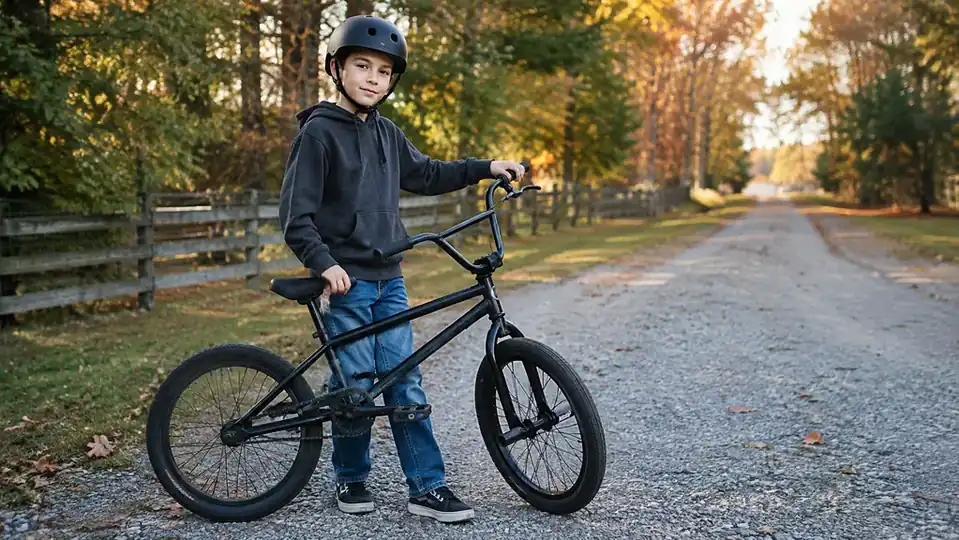
Last fall, my son Cody outgrew the cheap, heavy big-box bike he had been riding, and its brake had never been any good. Not the wheel size, exactly. The wheels were 20-inch and still fine. But he had to reach for the handlebars, the seat was at the top of its range, and every ride started with him telling me the bike felt small. That is how I ended up spending a weekend measuring him, measuring the bike, and learning how to size a kids BMX bike for a 10-year-old the right way. The bike we landed on was the Joystar Brockway BMX in the 20-inch wheel size, and the process I used is the same one I would use for any kid in this age range.
The short version is this: for a 10-year-old, wheel size matters most, then standover height, then seat height, then reach. If you get those four things in the right order, the bike will fit well enough that your kid can ride it safely and actually want to ride it. Here is the step-by-step method I used, with the Joystar Brockway BMX as the working example.
The 20-Inch Joystar Brockway BMX Is the Size I'd Start With for a 10-Year-Old
Cody is 4 foot 7 and about 75 pounds, and the 20-inch wheel size fits him with room to grow. If your kid is in that range, this is the size to measure against.
Amazon Check Today's Price on Amazon →Step 1: Measure Your Kid Before You Look at Any Bike
Before I even opened a browser tab, I had Cody stand against the wall in the garage with his shoes off and marked his height with a pencil. He is 4 foot 7. Then I measured his inseam, from the floor to the top of his inner thigh, which came out to about 22 inches. Those two numbers, height and inseam, are the only ones you actually need to start. Everything else is a comparison against the bike's numbers.
The reason the inseam matters more than total height is that a BMX bike is not like a road bike. You are not sitting upright with your feet reaching forward. You are leaning into the bars, and your feet need to reach the pedals comfortably. A kid with a long torso and short legs fits a different bike than a kid with short legs and a long torso, even at the same height. So measure both, write them down, and keep them on the workbench where you can see them while you work.
If you are sizing a bike as a gift and cannot measure the kid, use their height as the starting point and be honest about the guess. A 10-year-old is usually between 4 foot 4 and 4 foot 9, which is exactly the range the 20-inch wheel size is built for. That is why I started there for Cody.
Step 2: Match the Wheel Size to the Rider, Not to the Age
Kids bike sizing is built around wheel diameter, and the rule of thumb is simple: 12-inch wheels for the smallest riders, 16-inch for most 4 to 6 year olds, 18-inch for kids who are outgrowing 16 but not ready for 20, and 20-inch for most 7 to 12 year olds. A 10-year-old is almost always on a 20-inch wheel. The Joystar Brockway BMX comes in 20-inch and 24-inch sizes, and the listing says it is for ages 6 to 12. That is a wide range, which is why the age on the box matters less than the inseam measurement.
Here is the trap I almost fell into. Cody is on the smaller side for his age, so I briefly considered an 18-inch wheel bike to make the fit easier. But an 18-inch wheel bike is built for a shorter rider, which means the frame is shorter too. He would have outgrown it within a year, and I would have been back in the garage measuring him again next spring. The 20-inch wheel size is the right call for a 10-year-old of average height, and it gives you a couple of years of growth before you need to think about a 24-inch.
The other thing to check is the weight rating. The Joystar Brockway BMX listing is built for kids in the 6 to 12 age range, and Cody at 75 pounds is well inside it. If your kid is at the top of the weight range for a bike, the brakes and the wheels have to work harder, so do not push a smaller bike just because the seat post goes high enough. The frame has to be the right size, not just the seat.
Step 3: Set the Seat Height So One Foot Can Touch Flat
Once the bike was out of the box and assembled, the first thing I adjusted was the seat. The rule I use is simple: with Cody sitting on the seat and both hands on the bars, he should be able to put one foot flat on the ground without the bike tipping. He should not be on his tiptoes, and he should not be so flat-footed that his knees are up around his ears. One foot flat, the other on a pedal, is the sweet spot for a kid learning to ride a BMX bike.
I set the seat post with the quick release, had Cody sit on the bike while I held the handlebars, and adjusted until his foot sat flat. Then I marked the seat post with a piece of tape so I could see if it slipped. On the Joystar Brockway BMX, the seat post has a good range of adjustment, which matters because Cody is still growing. I set it about two inches below the maximum height, which leaves room to raise it as he grows without buying a longer seat post.
A note on the saddle itself. BMX seats are smaller and firmer than the seats on a typical kids bike, because they are designed for riders who are standing on the pedals a lot of the time. Cody noticed the difference right away. If your kid is used to a big padded seat, give them a few rides to adjust. The firmer seat is not a defect, it is part of the BMX design, and it stops the seat from getting in the way when they are standing to pedal over a bump.
Step 4: Set the Handlebar Height and Check the Reach
With the seat right, I moved to the handlebars. The test for reach is simple: with Cody seated and his hands on the grips, his elbows should be slightly bent. If his arms are locked straight, the bars are too far away. If his elbows are bent sharply and his back is hunched, the bars are too close. On the Joystar Brockway BMX, the handlebars are adjustable, so I set them so his back had a slight forward lean, which is the natural BMX riding position.
The handlebar height also affects the brakes. Cody's fingers are long enough to reach the brake levers now, but just barely. I adjusted the levers so they sat closer to the grips, which made a real difference in how confidently he could stop. If your kid cannot reach the brake levers comfortably, the bike is too big, no matter how the seat fits. Brakes are not optional, and a kid who cannot reach the levers will not use them.
I also checked the handlebar grips themselves. The Joystar Brockway BMX grips are sized for a kid's hands, which sounds obvious but is not true of every 20-inch bike. Some bikes use adult-sized grips that a 10-year-old has to stretch to hold. If the grips feel too thick in your kid's hands, that is a fit problem, not something they will grow into.
Step 5: Do the Standover Test and a Real Test Ride
The standover test is the one that catches most sizing mistakes. Have your kid stand over the top tube of the bike, with both feet flat on the ground. There should be a clear gap between the top tube and their body, at least an inch or two. If the top tube touches, the bike is too big, and it does not matter how good the deal was. Cody has about two inches of clearance on the Joystar Brockway BMX, which is exactly where I want it.
The standover test matters because of how kids actually get off a bike. They do not swing a leg over the back like an adult. They stand over the frame and step off. If the top tube is pressing against them, they cannot do that cleanly, and a fall that should be a simple step-off becomes a tumble. I have watched Cody do this a hundred times on the gravel driveway, and the clearance is what makes it look easy.
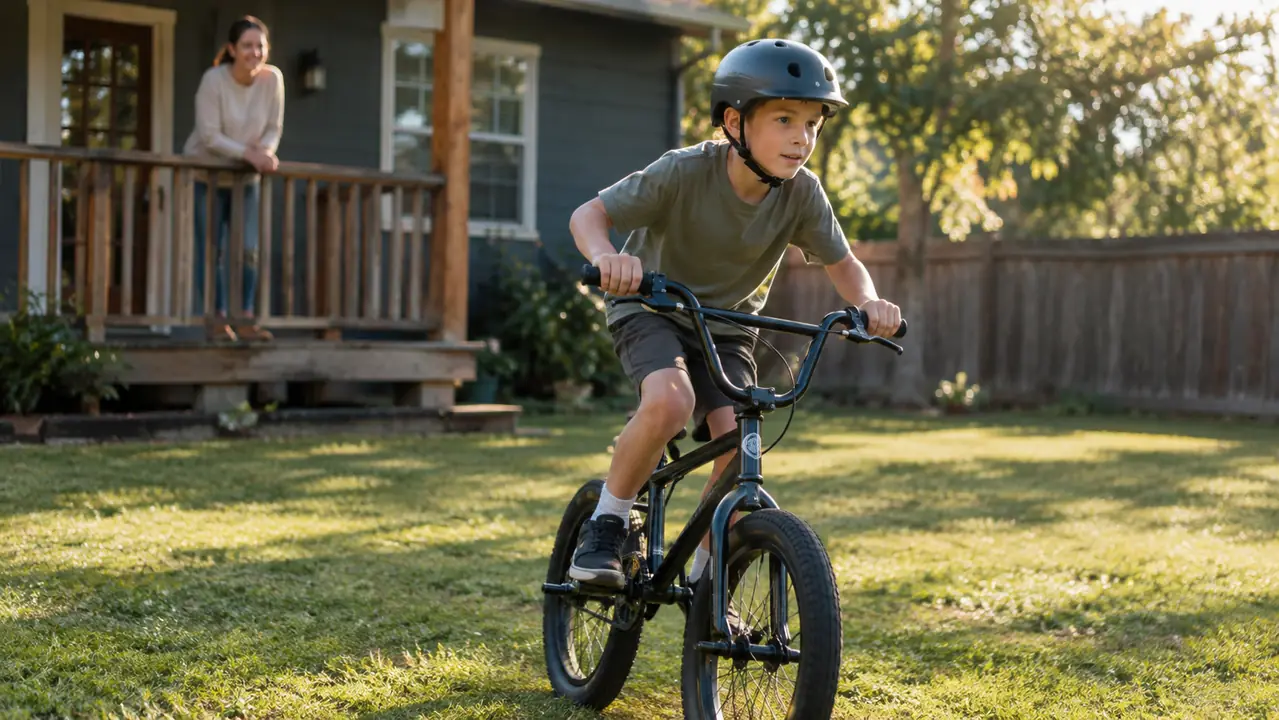
The last test is the real one. I had Cody ride the Joystar Brockway BMX around the flat grass back yard, then down the dirt trail along the tree line, then a few laps on the concrete pad in front of the garage. I watched three things: whether he could start and stop without help, whether his knees came up too high when he pedaled, and whether he looked comfortable or like he was hanging on. He looked comfortable, which is the whole point. A bike that fits is a bike a kid will actually ride.
What Else Helps
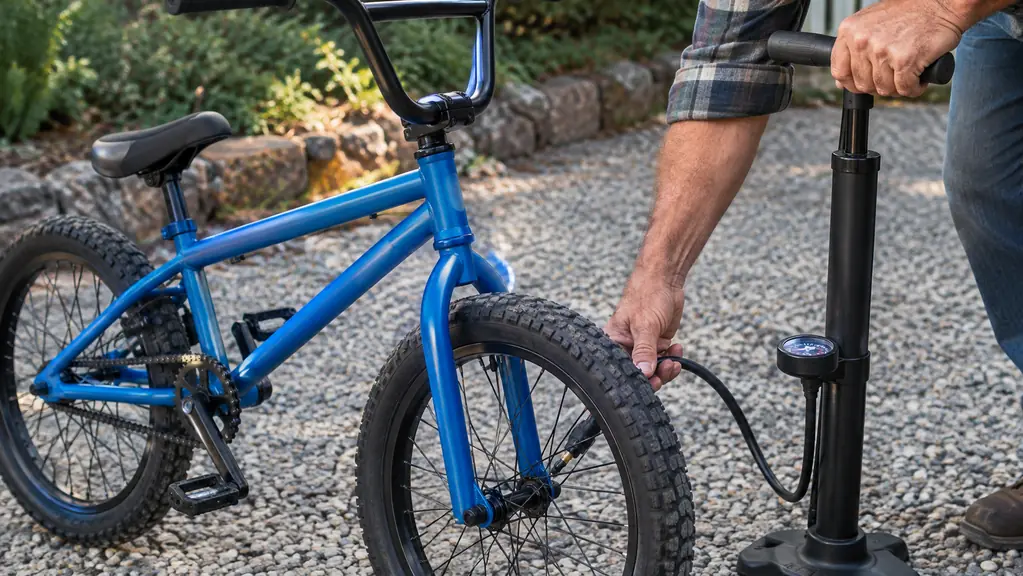
A correctly sized bike is only part of the setup. Cody wears the OUWOER Kids Bike Helmet on every ride, and I check the brakes and tire pressure before the season and after any crash. He rides on the gravel driveway, the grass back yard, the dirt trail and the concrete pad, always with me or my wife Jen outside, and he never rides on public roads. Closed-toe shoes, an adult outside, and a helmet that fits are not optional extras. They are the difference between a fun afternoon and a trip to urgent care.
One more thing I learned the hard way: check the brake reach again after the first few rides. Cables stretch, and a brake lever that was easy to reach on day one can be a stretch by week three. I keep a small wrench on the workbench and give the Joystar Brockway BMX a quick once-over every couple of weeks. It takes five minutes, and it catches small problems before they become bad habits.
A bike that fits is a bike a kid will actually ride. The standover test catches more sizing mistakes than any other check I do.
Measure Your Kid, Then Check the 20-Inch Joystar Brockway BMX
If your 10-year-old is in the 4 foot 4 to 4 foot 9 range, the 20-inch wheel size is the one to measure against. The Joystar Brockway BMX is the bike I used for this whole process.
Amazon Check Today's Price on Amazon →